Selection guide

Find materials by requirement

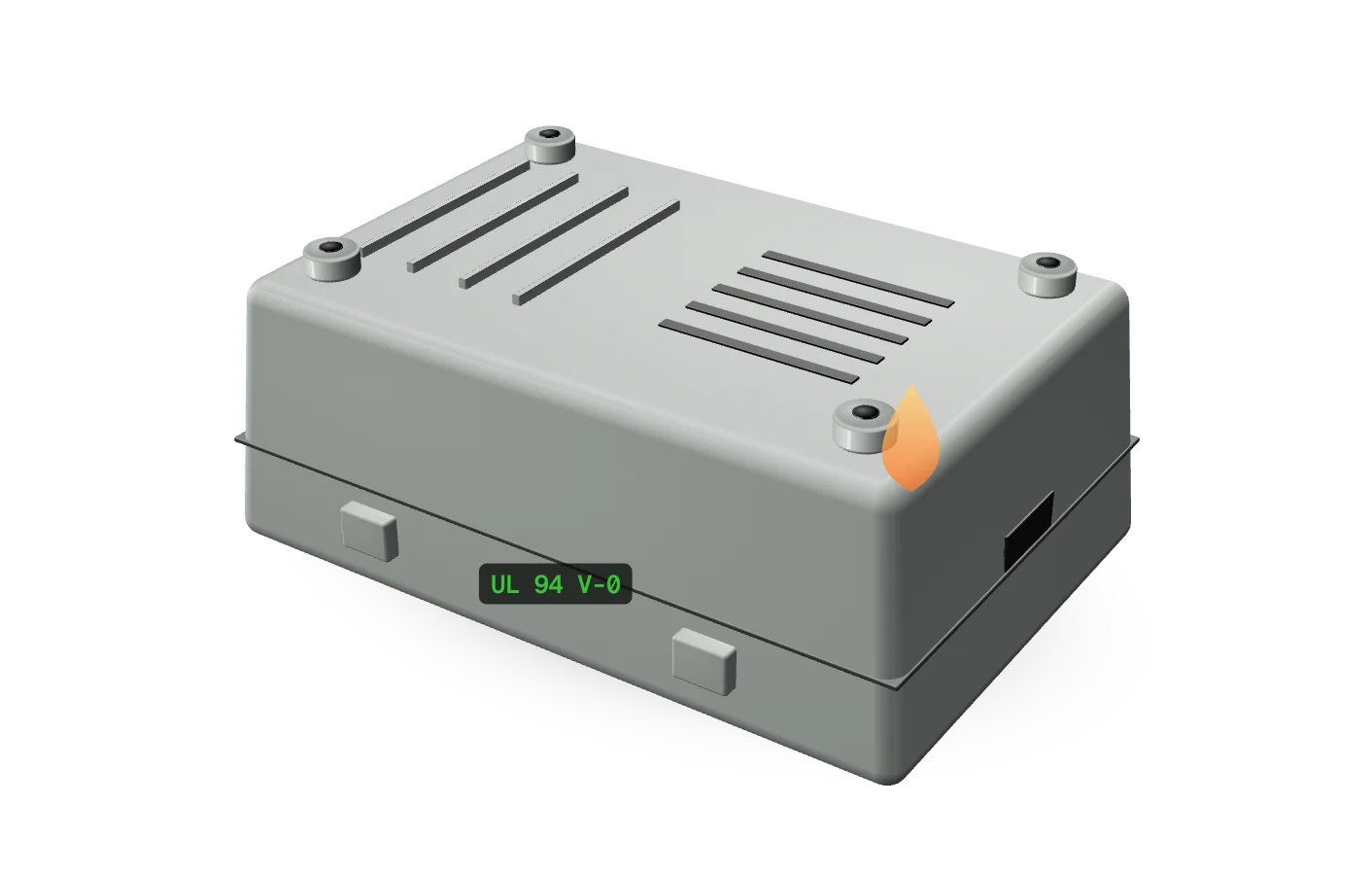
A light gray molded housing with screw bosses, vent slots and ribs on top, a small flame at one corner and a green UL 94 V-0 mark on its side.

V-0 flame retardancy, halogen-free

WhyPC chars easily when it burns, so it reaches high flammability ratings relatively easily even with halogen-free systems.

NoteA flammability rating belongs to a test thickness. "V-0 @ 1.5 mm" is not the same as "V-0 @ 1.0 mm". Check against the thinnest wall of the part.

  1. 01V-0 flame retardancy, halogen-free
  2. 02No fluorinated anti-drip agent (PFAS-free)
  3. 03High-gloss, mold-in-color (paint-free) cosmetic parts
  4. 04Outdoor use, weather resistance needed
  5. 05Must not become brittle at low temperatures
  6. 06Lightweighting by replacing metal with plastic
  7. 07Recycled (PCR) content needed
  8. 08Brand-specific colors needed
  9. 09Parts near heat sources, long-term heat resistance needed

28 / 28 grades match

Example grade / typical values — to be corrected by GREENPOLYMER

Grades by heat resistance and toughness
GradeNameHeat deflection temperature (°C)ISO 75-1/-2, 1.80 MPaCharpy notched impact strength (kJ/m²)ISO 179-1/1eA, 23 °CTensile strength (MPa)ISO 527-1/-2Flammability rating
GRN-PP-N510Halogen-free flame-retardant PP55–653–620–28V-0
GRN-ABS-F510Flame-retardant ABS75–858–1538–45V-0
GRN-PCA-N520Halogen-free flame-retardant PC/ABS (thin-wall, high-flow)75–888–2055–62V-0
GRN-ABS-G110General-purpose ABS80–9515–2540–50HB
GRN-ABS-H120High-impact ABS80–9025–4038–45HB
GRN-ABS-A110High-gloss ABS80–9012–2242–50HB
GRN-PCA-N510Halogen-free flame-retardant PC/ABS80–9510–3055–65V-0
GRN-PCA-S520Silicone-based flame-retardant PC/ABS85–10015–4050–60V-0
GRN-ASA-W110Weather-resistant ASA85–958–1540–50HB
GRN-PCAS-W510Flame-retardant weather-resistant PC/ASA85–10015–3548–58V-1
GRN-PPE-N510Halogen-free flame-retardant mPPE90–1208–1550–65V-0
GRN-POM-G110General-purpose copolymer POM90–1055–860–68HB
GRN-PCA-T310Heat-resistant PC/ABS95–11535–5550–60HB
GRN-PCA-H320Low-temperature high-impact PC/ABS95–11045–6548–56HB
GRN-PCA-W310Weather-resistant PC/ABS95–11035–5550–58HB
GRN-PCAS-W310Weather-resistant PC/ASA95–11030–5050–60HB
GRN-PCA-E510Flame-retardant glass-fiber-reinforced PC/ABS100–1206–1270–95V-0
GRN-PC-N510Halogen-free flame-retardant PC115–12820–5060–68V-0
GRN-PC-S520Silicone-based flame-retardant PC118–13035–6058–66V-0
GRN-PP-E510Flame-retardant glass-fiber-reinforced PP120–1455–950–70V-0
GRN-PC-L110Transparent PC125–13560–8060–68HB
GRN-PC-L120IR-transmissive black PC125–13560–8060–68HB
GRN-PA6-E510Flame-retardant glass-fiber-reinforced PA6 (GFRPA)190–2058–12130–160V-0
GRN-PA6-C510Flame-retardant carbon-fiber-reinforced PA6 (CFRPA)190–2106–10160–220V-0
GRN-PA6-C310Carbon-fiber-reinforced PA6 (CFRPA)200–2158–14180–250HB
GRN-PA6-E310Glass-fiber-reinforced PA6 (GF30, non-flame-retardant)200–21510–15160–190HB
GRN-PBT-E510Flame-retardant glass-fiber-reinforced PBT (high CTI)200–2156–10100–130V-0
GRN-PA66-E510Halogen-free flame-retardant glass-fiber-reinforced PA66230–2508–12140–170V-0

For buyers and R&D engineers. First define the requirements the part must meet, then look at the candidate grades and validation points. Typical values. Refer to the actual TDS. This applies to all values in the tables. For grade details, see Products.

Filter grades by requirement

Example grade / typical values — to be corrected by GREENPOLYMER

Requirement
Industry
Flammability (design target)
Sort
  • GRN-ABS-G110

    General-purpose ABSHDT 80–95 °CUL 94 HB
    Grade data

    GRN-ABS-G110

    General-purpose ABS

    Tensile strengthISO 527-1/-2
    40–50 MPa
    Charpy notched impact strengthISO 179-1/1eA · 23 °C
    15–25 kJ/m²
    Heat deflection temperatureISO 75-1/-2 · 1.80 MPa
    80–95 °C
    DensityISO 1183
    1.03–1.06 g/cm³
    MoreLess

    Typical values

    Flammability ratingUL 94 · 1.5 mm; design target, subject to test report
    HB

    Processing

    Drying
    80–85 °C, 2–4 h; moisture content below 0.1 % recommended
    Melt temperature
    210–250 °C; flame-retardant grades at the lower end, usually not above 230 °C
    Mold temperature
    40–80 °C; upper end for high-gloss parts

    Example grade / typical values — to be corrected by GREENPOLYMER

  • GRN-ABS-H120

    High-impact ABSHDT 80–90 °CUL 94 HB
    Grade data

    GRN-ABS-H120

    High-impact ABS

    Tensile strengthISO 527-1/-2
    38–45 MPa
    Charpy notched impact strengthISO 179-1/1eA · 23 °C
    25–40 kJ/m²
    Heat deflection temperatureISO 75-1/-2 · 1.80 MPa
    80–90 °C
    DensityISO 1183
    1.03–1.05 g/cm³
    MoreLess

    Typical values

    Flammability ratingUL 94 · 1.5 mm; design target, subject to test report
    HB

    Processing

    Drying
    80–85 °C, 2–4 h; moisture content below 0.1 % recommended
    Melt temperature
    210–250 °C; flame-retardant grades at the lower end, usually not above 230 °C
    Mold temperature
    40–80 °C; upper end for high-gloss parts

    Example grade / typical values — to be corrected by GREENPOLYMER

  • GRN-ABS-A110

    High-gloss ABSHDT 80–90 °CUL 94 HB
    Grade data

    GRN-ABS-A110

    High-gloss ABS

    Tensile strengthISO 527-1/-2
    42–50 MPa
    Charpy notched impact strengthISO 179-1/1eA · 23 °C
    12–22 kJ/m²
    Heat deflection temperatureISO 75-1/-2 · 1.80 MPa
    80–90 °C
    DensityISO 1183
    1.04–1.06 g/cm³
    MoreLess

    Typical values

    Flammability ratingUL 94 · 1.5 mm; design target, subject to test report
    HB

    Processing

    Drying
    80–85 °C, 2–4 h; moisture content below 0.1 % recommended
    Melt temperature
    210–250 °C; flame-retardant grades at the lower end, usually not above 230 °C
    Mold temperature
    40–80 °C; upper end for high-gloss parts

    Example grade / typical values — to be corrected by GREENPOLYMER

  • GRN-ABS-F510

    Flame-retardant ABSHDT 75–85 °CUL 94 V-0
    Grade data

    GRN-ABS-F510

    Flame-retardant ABS

    Tensile strengthISO 527-1/-2
    38–45 MPa
    Flammability ratingUL 94 · 1.5 mm; design target, subject to test report
    V-0
    Charpy notched impact strengthISO 179-1/1eA · 23 °C
    8–15 kJ/m²
    Heat deflection temperatureISO 75-1/-2 · 1.80 MPa
    75–85 °C
    MoreLess

    Typical values

    DensityISO 1183
    1.16–1.20 g/cm³

    Processing

    Drying
    80–85 °C, 2–4 h; moisture content below 0.1 % recommended
    Melt temperature
    210–250 °C; flame-retardant grades at the lower end, usually not above 230 °C
    Mold temperature
    40–80 °C; upper end for high-gloss parts

    Example grade / typical values — to be corrected by GREENPOLYMER

  • GRN-PCA-T310

    Heat-resistant PC/ABSHDT 95–115 °CUL 94 HB
    Grade data

    GRN-PCA-T310

    Heat-resistant PC/ABS

    Tensile strengthISO 527-1/-2
    50–60 MPa
    Charpy notched impact strengthISO 179-1/1eA · 23 °C
    35–55 kJ/m²
    Heat deflection temperatureISO 75-1/-2 · 1.80 MPa
    95–115 °C
    DensityISO 1183
    1.12–1.16 g/cm³
    MoreLess

    Typical values

    Flammability ratingUL 94 · 1.5 mm; design target, subject to test report
    HB

    Processing

    Drying
    100–110 °C, 3–4 h
    Melt temperature
    250–280 °C
    Mold temperature
    60–90 °C

    Example grade / typical values — to be corrected by GREENPOLYMER

  • GRN-PCA-H320

    Low-temperature high-impact PC/ABSHDT 95–110 °CUL 94 HB
    Grade data

    GRN-PCA-H320

    Low-temperature high-impact PC/ABS

    Tensile strengthISO 527-1/-2
    48–56 MPa
    Charpy notched impact strengthISO 179-1/1eA · 23 °C; −30 °C: 25–40 kJ/m²
    45–65 kJ/m²
    Heat deflection temperatureISO 75-1/-2 · 1.80 MPa
    95–110 °C
    DensityISO 1183
    1.12–1.15 g/cm³
    MoreLess

    Typical values

    Flammability ratingUL 94 · 1.5 mm; design target, subject to test report
    HB

    Processing

    Drying
    100–110 °C, 3–4 h
    Melt temperature
    250–280 °C
    Mold temperature
    60–90 °C

    Example grade / typical values — to be corrected by GREENPOLYMER

  • GRN-PCA-W310

    Weather-resistant PC/ABSHDT 95–110 °CUL 94 HB
    Grade data

    GRN-PCA-W310

    Weather-resistant PC/ABS

    Tensile strengthISO 527-1/-2
    50–58 MPa
    Weathering (color difference)ISO 4892-2 · Xenon-arc 1000 h; design target
    ΔE ≤ 3
    Charpy notched impact strengthISO 179-1/1eA · 23 °C
    35–55 kJ/m²
    Heat deflection temperatureISO 75-1/-2 · 1.80 MPa
    95–110 °C
    MoreLess

    Typical values

    DensityISO 1183
    1.12–1.16 g/cm³
    Flammability ratingUL 94 · 1.5 mm; design target, subject to test report
    HB

    Processing

    Drying
    100–110 °C, 3–4 h
    Melt temperature
    250–280 °C
    Mold temperature
    60–90 °C

    Example grade / typical values — to be corrected by GREENPOLYMER

  • GRN-PCA-N510

    Halogen-free flame-retardant PC/ABSHDT 80–95 °CUL 94 V-0
    Grade data

    GRN-PCA-N510

    Halogen-free flame-retardant PC/ABS

    Tensile strengthISO 527-1/-2
    55–65 MPa
    Flammability ratingUL 94 · 1.5 mm; design target, subject to test report
    V-0
    Charpy notched impact strengthISO 179-1/1eA · 23 °C
    10–30 kJ/m²
    Heat deflection temperatureISO 75-1/-2 · 1.80 MPa
    80–95 °C
    MoreLess

    Typical values

    DensityISO 1183
    1.17–1.20 g/cm³

    Processing

    Drying
    100–110 °C, 3–4 h
    Melt temperature
    250–280 °C
    Mold temperature
    60–90 °C

    Example grade / typical values — to be corrected by GREENPOLYMER

  • GRN-PCA-N520

    Halogen-free flame-retardant PC/ABS (thin-wall, high-flow)HDT 75–88 °CUL 94 V-0
    Grade data

    GRN-PCA-N520

    Halogen-free flame-retardant PC/ABS (thin-wall, high-flow)

    Tensile strengthISO 527-1/-2
    55–62 MPa
    Flammability ratingUL 94 · 1.0 mm; design target, subject to test report
    V-0
    Charpy notched impact strengthISO 179-1/1eA · 23 °C
    8–20 kJ/m²
    Heat deflection temperatureISO 75-1/-2 · 1.80 MPa
    75–88 °C
    MoreLess

    Typical values

    DensityISO 1183
    1.17–1.20 g/cm³

    Processing

    Drying
    100–110 °C, 3–4 h
    Melt temperature
    250–280 °C
    Mold temperature
    60–90 °C

    Example grade / typical values — to be corrected by GREENPOLYMER

  • GRN-PCA-S520

    Silicone-based flame-retardant PC/ABSHDT 85–100 °CUL 94 V-0
    Grade data

    GRN-PCA-S520

    Silicone-based flame-retardant PC/ABS

    Tensile strengthISO 527-1/-2
    50–60 MPa
    Flammability ratingUL 94 · 1.5 mm; design target, subject to test report
    V-0
    Charpy notched impact strengthISO 179-1/1eA · 23 °C
    15–40 kJ/m²
    Heat deflection temperatureISO 75-1/-2 · 1.80 MPa
    85–100 °C
    MoreLess

    Typical values

    DensityISO 1183
    1.15–1.20 g/cm³

    Processing

    Drying
    100–110 °C, 3–4 h
    Melt temperature
    250–280 °C
    Mold temperature
    60–90 °C

    Example grade / typical values — to be corrected by GREENPOLYMER

  • GRN-PCA-E510

    Flame-retardant glass-fiber-reinforced PC/ABSHDT 100–120 °CUL 94 V-0
    Grade data

    GRN-PCA-E510

    Flame-retardant glass-fiber-reinforced PC/ABS

    Tensile strengthISO 527-1/-2
    70–95 MPa
    Flammability ratingUL 94 · 1.5 mm; design target, subject to test report
    V-0
    Flexural modulusISO 178
    4–6.5 GPa
    Heat deflection temperatureISO 75-1/-2 · 1.80 MPa
    100–120 °C
    MoreLess

    Typical values

    Charpy notched impact strengthISO 179-1/1eA · 23 °C
    6–12 kJ/m²
    DensityISO 1183
    1.25–1.35 g/cm³

    Processing

    Drying
    100–110 °C, 3–4 h
    Melt temperature
    250–280 °C
    Mold temperature
    60–90 °C

    Example grade / typical values — to be corrected by GREENPOLYMER

  • GRN-PC-N510

    Halogen-free flame-retardant PCHDT 115–128 °CUL 94 V-0
    Grade data

    GRN-PC-N510

    Halogen-free flame-retardant PC

    Tensile strengthISO 527-1/-2
    60–68 MPa
    Flammability ratingUL 94 · 1.5 mm; design target, subject to test report
    V-0
    Charpy notched impact strengthISO 179-1/1eA · 23 °C
    20–50 kJ/m²
    Heat deflection temperatureISO 75-1/-2 · 1.80 MPa
    115–128 °C
    MoreLess

    Typical values

    DensityISO 1183
    1.20–1.24 g/cm³

    Processing

    Drying
    120 °C, 3–4 h; moisture content ≤ 0.02 % recommended
    Melt temperature
    280–310 °C; for flame-retardant grades keep within the TDS upper limit
    Mold temperature
    80–110 °C

    Example grade / typical values — to be corrected by GREENPOLYMER

  • GRN-PC-S520

    Silicone-based flame-retardant PCHDT 118–130 °CUL 94 V-0
    Grade data

    GRN-PC-S520

    Silicone-based flame-retardant PC

    Tensile strengthISO 527-1/-2
    58–66 MPa
    Flammability ratingUL 94 · 1.5 mm; design target, subject to test report
    V-0
    Charpy notched impact strengthISO 179-1/1eA · 23 °C
    35–60 kJ/m²
    Heat deflection temperatureISO 75-1/-2 · 1.80 MPa
    118–130 °C
    MoreLess

    Typical values

    DensityISO 1183
    1.19–1.22 g/cm³

    Processing

    Drying
    120 °C, 3–4 h; moisture content ≤ 0.02 % recommended
    Melt temperature
    280–310 °C; for flame-retardant grades keep within the TDS upper limit
    Mold temperature
    80–110 °C

    Example grade / typical values — to be corrected by GREENPOLYMER

  • GRN-PA6-E510

    Flame-retardant glass-fiber-reinforced PA6 (GFRPA)HDT 190–205 °CUL 94 V-0
    Grade data

    GRN-PA6-E510

    Flame-retardant glass-fiber-reinforced PA6 (GFRPA)

    Tensile strengthISO 527-1/-2 · dry
    130–160 MPa
    Flammability ratingUL 94 · 1.5 mm; design target, subject to test report
    V-0
    Flexural modulusISO 178
    8–10 GPa
    Heat deflection temperatureISO 75-1/-2 · 1.80 MPa
    190–205 °C
    MoreLess

    Typical values

    Charpy notched impact strengthISO 179-1/1eA · 23 °C; dry
    8–12 kJ/m²
    DensityISO 1183
    1.40–1.50 g/cm³

    Processing

    Drying
    80 °C, 4–6 h (desiccant dryer); moisture content 0.05–0.2 % recommended
    Melt temperature
    260–290 °C
    Mold temperature
    80–100 °C; upper end for a better surface

    Example grade / typical values — to be corrected by GREENPOLYMER

  • GRN-PA6-C510

    Flame-retardant carbon-fiber-reinforced PA6 (CFRPA)HDT 190–210 °CUL 94 V-0
    Grade data

    GRN-PA6-C510

    Flame-retardant carbon-fiber-reinforced PA6 (CFRPA)

    Tensile strengthISO 527-1/-2 · dry
    160–220 MPa
    Flammability ratingUL 94 · 1.5 mm; design target, subject to test report
    V-0
    Flexural modulusISO 178
    12–18 GPa
    Heat deflection temperatureISO 75-1/-2 · 1.80 MPa
    190–210 °C
    MoreLess

    Typical values

    Charpy notched impact strengthISO 179-1/1eA · 23 °C; dry
    6–10 kJ/m²
    DensityISO 1183
    1.25–1.35 g/cm³

    Processing

    Drying
    80 °C, 4–6 h (desiccant dryer); moisture content 0.05–0.2 % recommended
    Melt temperature
    260–290 °C
    Mold temperature
    80–100 °C; upper end for a better surface

    Example grade / typical values — to be corrected by GREENPOLYMER

  • GRN-PA6-C310

    Carbon-fiber-reinforced PA6 (CFRPA)HDT 200–215 °CUL 94 HB
    Grade data

    GRN-PA6-C310

    Carbon-fiber-reinforced PA6 (CFRPA)

    Tensile strengthISO 527-1/-2 · dry
    180–250 MPa
    Flexural modulusISO 178
    13–20 GPa
    Heat deflection temperatureISO 75-1/-2 · 1.80 MPa
    200–215 °C
    Charpy notched impact strengthISO 179-1/1eA · 23 °C; dry
    8–14 kJ/m²
    MoreLess

    Typical values

    DensityISO 1183
    1.20–1.28 g/cm³
    Flammability ratingUL 94 · 1.5 mm; design target, subject to test report
    HB

    Processing

    Drying
    80 °C, 4–6 h (desiccant dryer); moisture content 0.05–0.2 % recommended
    Melt temperature
    260–290 °C
    Mold temperature
    80–100 °C; upper end for a better surface

    Example grade / typical values — to be corrected by GREENPOLYMER

  • GRN-PA6-E310

    Glass-fiber-reinforced PA6 (GF30, non-flame-retardant)HDT 200–215 °CUL 94 HB
    Grade data

    GRN-PA6-E310

    Glass-fiber-reinforced PA6 (GF30, non-flame-retardant)

    Tensile strengthISO 527-1/-2 · dry
    160–190 MPa
    Flexural modulusISO 178 · dry
    8.5–10 GPa
    Heat deflection temperatureISO 75-1/-2 · 1.80 MPa
    200–215 °C
    Charpy notched impact strengthISO 179-1/1eA · 23 °C; dry
    10–15 kJ/m²
    MoreLess

    Typical values

    DensityISO 1183
    1.34–1.38 g/cm³
    Flammability ratingUL 94 · 1.5 mm; design target, subject to test report
    HB

    Processing

    Drying
    80 °C, 4–6 h (desiccant dryer); moisture content 0.05–0.2 % recommended
    Melt temperature
    260–290 °C
    Mold temperature
    80–100 °C; upper end for a better surface

    Example grade / typical values — to be corrected by GREENPOLYMER

  • GRN-PA66-E510

    Halogen-free flame-retardant glass-fiber-reinforced PA66HDT 230–250 °CUL 94 V-0
    Grade data

    GRN-PA66-E510

    Halogen-free flame-retardant glass-fiber-reinforced PA66

    Tensile strengthISO 527-1/-2 · dry
    140–170 MPa
    Flammability ratingUL 94 · 1.5 mm; design target, subject to test report
    V-0
    Flexural modulusISO 178
    8–10 GPa
    Heat deflection temperatureISO 75-1/-2 · 1.80 MPa
    230–250 °C
    MoreLess

    Typical values

    Charpy notched impact strengthISO 179-1/1eA · 23 °C; dry
    8–12 kJ/m²
    DensityISO 1183
    1.45–1.55 g/cm³

    Processing

    Drying
    80 °C, 4–6 h (desiccant dryer); moisture content 0.05–0.2 % recommended
    Melt temperature
    280–300 °C; do not exceed the TDS upper limit for flame-retardant grades
    Mold temperature
    80–110 °C

    Example grade / typical values — to be corrected by GREENPOLYMER

  • GRN-PBT-E510

    Flame-retardant glass-fiber-reinforced PBT (high CTI)HDT 200–215 °CUL 94 V-0
    Grade data

    GRN-PBT-E510

    Flame-retardant glass-fiber-reinforced PBT (high CTI)

    Tensile strengthISO 527-1/-2
    100–130 MPa
    Comparative tracking index (CTI)IEC 60112 · design target
    ≥ 600 V
    Flammability ratingUL 94 · 1.5 mm; design target, subject to test report
    V-0
    Flexural modulusISO 178
    8–10 GPa
    MoreLess

    Typical values

    Heat deflection temperatureISO 75-1/-2 · 1.80 MPa
    200–215 °C
    Charpy notched impact strengthISO 179-1/1eA · 23 °C
    6–10 kJ/m²
    DensityISO 1183
    1.55–1.70 g/cm³

    Processing

    Drying
    120 °C, 3–4 h (desiccant dryer); moisture content ≤ 0.02 %
    Melt temperature
    240–270 °C
    Mold temperature
    60–90 °C; upper end when surface and dimensional stability matter

    Example grade / typical values — to be corrected by GREENPOLYMER

  • GRN-PPE-N510

    Halogen-free flame-retardant mPPEHDT 90–120 °CUL 94 V-0
    Grade data

    GRN-PPE-N510

    Halogen-free flame-retardant mPPE

    Tensile strengthISO 527-1/-2
    50–65 MPa
    Flammability ratingUL 94 · 1.5 mm; design target, subject to test report
    V-0
    Charpy notched impact strengthISO 179-1/1eA · 23 °C
    8–15 kJ/m²
    Heat deflection temperatureISO 75-1/-2 · 1.80 MPa
    90–120 °C
    MoreLess

    Typical values

    DensityISO 1183
    1.06–1.12 g/cm³

    Processing

    Drying
    100–110 °C, 2–4 h
    Melt temperature
    260–300 °C
    Mold temperature
    70–100 °C

    Example grade / typical values — to be corrected by GREENPOLYMER

  • GRN-PP-N510

    Halogen-free flame-retardant PPHDT 55–65 °CUL 94 V-0
    Grade data

    GRN-PP-N510

    Halogen-free flame-retardant PP

    Tensile strengthISO 527-1/-2
    20–28 MPa
    Flammability ratingUL 94 · 1.5 mm; design target, subject to test report
    V-0
    Charpy notched impact strengthISO 179-1/1eA · 23 °C
    3–6 kJ/m²
    Heat deflection temperatureISO 75-1/-2 · 1.80 MPa
    55–65 °C
    MoreLess

    Typical values

    DensityISO 1183
    1.00–1.10 g/cm³

    Processing

    Drying
    Usually not needed; if damp, 80 °C, 1–2 h
    Melt temperature
    190–220 °C (not too high for flame-retardant grades)
    Mold temperature
    30–60 °C

    Example grade / typical values — to be corrected by GREENPOLYMER

  • GRN-PP-E510

    Flame-retardant glass-fiber-reinforced PPHDT 120–145 °CUL 94 V-0
    Grade data

    GRN-PP-E510

    Flame-retardant glass-fiber-reinforced PP

    Tensile strengthISO 527-1/-2
    50–70 MPa
    Flammability ratingUL 94 · 1.5 mm; design target, subject to test report
    V-0
    Flexural modulusISO 178
    4–6 GPa
    Heat deflection temperatureISO 75-1/-2 · 1.80 MPa
    120–145 °C
    MoreLess

    Typical values

    Charpy notched impact strengthISO 179-1/1eA · 23 °C
    5–9 kJ/m²
    DensityISO 1183
    1.15–1.30 g/cm³

    Processing

    Drying
    Usually not needed; if damp, 80 °C, 1–2 h
    Melt temperature
    190–220 °C (not too high for flame-retardant grades)
    Mold temperature
    30–60 °C

    Example grade / typical values — to be corrected by GREENPOLYMER

  • GRN-ASA-W110

    Weather-resistant ASAHDT 85–95 °CUL 94 HB
    Grade data

    GRN-ASA-W110

    Weather-resistant ASA

    Tensile strengthISO 527-1/-2
    40–50 MPa
    Weathering (color difference)ISO 4892-2 · Xenon-arc 1000 h; design target
    ΔE ≤ 3
    Charpy notched impact strengthISO 179-1/1eA · 23 °C
    8–15 kJ/m²
    Heat deflection temperatureISO 75-1/-2 · 1.80 MPa
    85–95 °C
    MoreLess

    Typical values

    DensityISO 1183
    1.06–1.08 g/cm³
    Flammability ratingUL 94 · 1.5 mm; design target, subject to test report
    HB

    Processing

    Drying
    80–85 °C, 2–4 h
    Melt temperature
    230–260 °C
    Mold temperature
    50–80 °C

    Example grade / typical values — to be corrected by GREENPOLYMER

  • GRN-PCAS-W310

    Weather-resistant PC/ASAHDT 95–110 °CUL 94 HB
    Grade data

    GRN-PCAS-W310

    Weather-resistant PC/ASA

    Tensile strengthISO 527-1/-2
    50–60 MPa
    Weathering (color difference)ISO 4892-2 · Xenon-arc 1000 h; design target
    ΔE ≤ 3
    Charpy notched impact strengthISO 179-1/1eA · 23 °C
    30–50 kJ/m²
    Heat deflection temperatureISO 75-1/-2 · 1.80 MPa
    95–110 °C
    MoreLess

    Typical values

    DensityISO 1183
    1.14–1.17 g/cm³
    Flammability ratingUL 94 · 1.5 mm; design target, subject to test report
    HB

    Processing

    Drying
    80–85 °C, 2–4 h
    Melt temperature
    230–260 °C
    Mold temperature
    50–80 °C

    Example grade / typical values — to be corrected by GREENPOLYMER

  • GRN-PCAS-W510

    Flame-retardant weather-resistant PC/ASAHDT 85–100 °CUL 94 V-1
    Grade data

    GRN-PCAS-W510

    Flame-retardant weather-resistant PC/ASA

    Tensile strengthISO 527-1/-2
    48–58 MPa
    Weathering (color difference)ISO 4892-2 · Xenon-arc 1000 h; design target
    ΔE ≤ 3
    Flammability ratingGB/T 5169.16 / UL 94 · 1.5 mm; design target, subject to test report
    V-1
    Charpy notched impact strengthISO 179-1/1eA · 23 °C
    15–35 kJ/m²
    MoreLess

    Typical values

    Heat deflection temperatureISO 75-1/-2 · 1.80 MPa
    85–100 °C
    DensityISO 1183
    1.18–1.25 g/cm³

    Processing

    Drying
    80–85 °C, 2–4 h
    Melt temperature
    230–260 °C
    Mold temperature
    50–80 °C

    Example grade / typical values — to be corrected by GREENPOLYMER

  • GRN-PC-L110

    Transparent PCHDT 125–135 °CUL 94 HB
    Grade data

    GRN-PC-L110

    Transparent PC

    Tensile strengthISO 527-1/-2
    60–68 MPa
    Light transmittanceISO 13468-1 · 3 mm; design target
    ≥ 88 %
    Charpy notched impact strengthISO 179-1/1eA · 23 °C
    60–80 kJ/m²
    Heat deflection temperatureISO 75-1/-2 · 1.80 MPa
    125–135 °C
    MoreLess

    Typical values

    DensityISO 1183
    1.19–1.21 g/cm³
    Flammability ratingUL 94 · 1.5 mm; design target, subject to test report
    HB

    Processing

    Drying
    120 °C, 3–4 h; moisture content ≤ 0.02 % recommended
    Melt temperature
    280–310 °C; for flame-retardant grades keep within the TDS upper limit
    Mold temperature
    80–110 °C

    Example grade / typical values — to be corrected by GREENPOLYMER

  • GRN-PC-L120

    IR-transmissive black PCHDT 125–135 °CUL 94 HB
    Grade data

    GRN-PC-L120

    IR-transmissive black PC

    Tensile strengthISO 527-1/-2
    60–68 MPa
    Charpy notched impact strengthISO 179-1/1eA · 23 °C
    60–80 kJ/m²
    Heat deflection temperatureISO 75-1/-2 · 1.80 MPa
    125–135 °C
    DensityISO 1183
    1.19–1.21 g/cm³
    MoreLess

    Typical values

    Flammability ratingUL 94 · 1.5 mm; design target, subject to test report
    HB

    Processing

    Drying
    120 °C, 3–4 h; moisture content ≤ 0.02 % recommended
    Melt temperature
    280–310 °C; for flame-retardant grades keep within the TDS upper limit
    Mold temperature
    80–110 °C

    Example grade / typical values — to be corrected by GREENPOLYMER

  • GRN-POM-G110

    General-purpose copolymer POMHDT 90–105 °CUL 94 HB
    Grade data

    GRN-POM-G110

    General-purpose copolymer POM

    Tensile strengthISO 527-1/-2
    60–68 MPa
    Flexural modulusISO 178
    2.4–2.9 GPa
    Heat deflection temperatureISO 75-1/-2 · 1.80 MPa
    90–105 °C
    Charpy notched impact strengthISO 179-1/1eA · 23 °C
    5–8 kJ/m²
    MoreLess

    Typical values

    DensityISO 1183
    1.39–1.42 g/cm³
    Flammability ratingUL 94 · 1.5 mm; design target, subject to test report
    HB

    Processing

    Drying
    Usually not needed; if damp, 80 °C, 2–3 h
    Melt temperature
    190–210 °C; do not exceed 230 °C
    Mold temperature
    60–90 °C; upper end for precision parts, for more stable dimensions

    Example grade / typical values — to be corrected by GREENPOLYMER

Selecting 3D printing materials

Printing purposeRecommended filamentNotes
Appearance models, teaching, design prototypesGRN3D-PLA-S01, GRN3D-PLA-H01, GRN3D-PLA-W01The HDT of PLA is about 50–60 °C (0.45 MPa, typical value). Not suitable for high-temperature environments
Everyday functional parts that need some toughnessGRN3D-PETG-S01Keep dry. Strings easily; retraction needs tuning
Stiffness and a matte surface neededGRN3D-PETG-C01Hardened steel nozzle required
Heat-resistant, impact-resistant functional prototypesGRN3D-ABS-E01, GRN3D-PCA-E01An enclosed chamber is recommended to reduce warpage and odor
High-stiffness structural parts, jigs and fixturesGRN3D-PA6-C20Must be dried before printing. Hardened steel nozzle required
Flexible parts, damping partsGRN3D-TPU-F95, GRN3D-TPU-F85Print slowly. Direct-drive extrusion is more stable
High-detail small modelsGRN3D-RSN-S01, GRN3D-RSN-T01Choose by the printer's light source. Wash and post-cure after printing, and use personal protection

For all 3D products (five groups), see the filament overview; to compare them, see the comparison table.

Note

  • Printed parts do not perform like molded parts. Their properties depend strongly on print orientation, layer height and infill. Test functional parts as actually printed.
  • Flammability results or certifications of pellets do not apply directly to filaments or printed parts.

Candidates by requirement

V-0 flame retardancy, halogen-free

GRN-PCA-N510 · GRN-PCA-N520 · GRN-PC-N510
Candidate grades

GRN-PCA-N510, GRN-PCA-N520 (thin wall), GRN-PC-N510.

Why

PC chars easily when it burns, so it reaches high flammability ratings relatively easily even with halogen-free systems. Halogen-free V-0 is harder with ABS systems and usually lowers toughness and flow.

Note
  • A flammability rating belongs to a test thickness. "V-0 @ 1.5 mm" is not the same as "V-0 @ 1.0 mm". Check against the thinnest wall of the part.
  • "Halogen-free" needs a clear basis. A common practice is to use the halogen limits of IEC 61249-2-21 or your specification, with a third-party test report.
  • Color affects flammability results. Check dark and light colors separately.

No fluorinated anti-drip agent

PFAS-free

GRN-PCA-S520 · GRN-PC-S520
Candidate grades

GRN-PCA-S520, GRN-PC-S520. Both use a silicone-based flame-retardant system without PTFE anti-drip agent.

Why

Many flame-retardant formulations use PTFE to prevent dripping during burning. PTFE is a fluoropolymer, and the EU PFAS restriction proposal covers this kind of substance. Export brands are starting to require "fluorine-free" in their material specifications.

Note

Please send us your restricted substance list. We confirm the test items one by one against the list and can arrange third-party testing on request.

High-gloss, mold-in-color cosmetic parts

GRN-ABS-A110 · GRN-PCA-T310
Candidate grades

GRN-ABS-A110; choose GRN-PCA-T310 when higher heat resistance or toughness is needed.

Why

Mold-in-color parts remove the painting step, reducing VOC emissions and reject rates. But they place higher demands on material flow, pigment dispersion and the mold.

Note
  • Weld lines and flow marks depend mainly on the mold and process. It is best to evaluate the mold design together with the material.
  • The color plaque you approve is the reference. Agree on the color difference (ΔE) acceptance criteria in advance.

Outdoor use, weather resistance needed

GRN-PCA-W310
Candidate grades

GRN-PCA-W310. For higher requirements, discuss weather-resistant options such as ASA with GREENPOLYMER engineers.

Why

Standard ABS yellows and becomes brittle under UV light. Outdoor parts need dedicated weather-resistant formulations.

Note
  • Set the accelerated aging test to the sunlight conditions of the target region. Xenon-arc (ISO 4892-2) or UV lamps are commonly used.
  • Judge by color difference and impact retention after aging, not by appearance alone.

Must not become brittle at low temperatures

GRN-PCA-H320 · GRN-PC-N510
Candidate grades

GRN-PCA-H320; choose GRN-PC-N510 when flame retardancy is needed.

Why

Many materials are tough at room temperature, but their impact strength drops clearly at −20 °C to −40 °C. Outdoor equipment, drones and cold-chain products all face these conditions.

Note

Test low-temperature impact at the actual lowest service temperature. Keep the test method and specimen condition (notch, thickness) the same.

Lightweighting by replacing metal with plastic

GRN-PA6-C310 · GRN-PA6-C510 · GRN-PA6-E510
Candidate grades

GRN-PA6-C310, GRN-PA6-C510 (carbon-fiber-reinforced); GRN-PA6-E510 (glass-fiber-reinforced).

Why

Carbon-fiber-reinforced PA6 has a density of about 1.2–1.35 g/cm³; aluminum alloy is about 2.7 g/cm³ (Typical values. Refer to the actual TDS.). Reinforced materials can also mold complex structures in one shot and reduce machining.

Note
  • Fiber orientation causes anisotropy. Consider gate location and load direction in the design.
  • Moisture absorption lowers the strength and modulus of nylon. Use conditioned values for design.
  • Carbon fiber materials may be electrically conductive. Check before using them for insulating parts.

Recycled (PCR) content needed

Candidate grades

The recycled version of each grade (grade code with -R).

Why

Brand carbon reduction targets and recycled material requirements in export markets are driving the use of PCR.

Note
  • Recycled content can be customized to your needs, with traceability documents. Please state the definition of the recycled material (post-consumer PCR or post-industrial PIR) and the target ratio.
  • Recycled material varies more from batch to batch than virgin material. Validate several batches before mass production.
  • Recycled material certificates: Certificate to be uploaded.

Brand-specific colors needed

Service

Custom color matching to RAL or Pantone codes and to your physical color samples.

Why

When color is matched at the compounding stage, the color is more even than adding masterbatch at molding, and more stable between batches.

Note
  • Please provide a color plaque or color code, and state the gloss level, light source and acceptance method.
  • Color affects properties such as flammability and weathering. Confirm key properties again after color matching.

Parts near heat sources, long-term heat resistance needed

GRN-PC-N510 · GRN-PC-S520 · GRN-PCA-E510 · GRN-PA6-E510
Candidate grades

GRN-PC-N510, GRN-PC-S520; choose GRN-PCA-E510 or GRN-PA6-E510 when stiffness is needed.

Why

HDT only reflects short-term heat resistance. For parts working at high temperatures for long periods, also check the RTI (UL 746B) and property retention after heat aging.

Note

Select materials on actual temperature rise data and leave a safety margin. For electrical parts, also confirm the comparative tracking index (CTI) and glow-wire performance.

Contact us

Need help? Tell us the part's use, performance targets and processing method: phone +86 18822892298 | email hello@greenpolymer.com